Monday, 22 December 2014

Library Lavender

It is still hanging on for dear life in straggling flower, the lavender of the library park. Tucked away in the flower beds underneath the looming hedge of the bowling green, now a bowling over-green and looking winterly unkempt.

Every day I've walked past since April, I squeezed the lilac flowers in my fingers, and inhaled deeply the sweet scent. This variety is the one with the silvery leaves, and a rather garden herb tang to the smell compared with more floral ones. It almost reminds me of rosemary, and creates a craving for lamb in my calorie hungry body.

I've watched it through the season, a paradise of bumblebees, honeybees and butterflies with large white and holly blue being particularly attracted to the flowers. Virtually every day in summer I struggled to photograph some buzzing or fluttering creature amongst the blooms.

Now it stands lonely in the park, no life but its own. But it still smells beautiful, and the months count down to when it will be a wildlife haven again.

The days have already started to lengthen...


posted from Bloggeroid

Sunday, 21 December 2014

The Post Industrial Owl Country Pictorial

Third time in a row, I explored owl country, but decided not to run flat out, and instead explore and take some photographs.

It was worth it.

I love Owl Country. I haven't yet actually seen any owls, but to me there is an inherent excitement about running across ground that had an industrial use in the past; man has given way and nature is re-encroaching. The open, scrubby nature of the area is prime barn owl and short-eared owl territory because of this, and just because I, a not terribly amazing birdwatcher, hasn't seen any doesn't mean they aren't there.

So along paths of broken brick and worn concrete I ran, startling up partridge and chaffinch, and noting how many magpies there seems to be this winter; everywhere you look there is yet another piebald body and long tail riding the winds.

I got round to the Cotham Flash eventually, and with the water level there rather low - has it been drained? - I was able to go running through it. A big raptor was making its way low over the reeds, and initially I thought it was a marsh harrier; its behaviour and flight didn't seem very buzzard like. But, I doubt you'd find a marsh harrier round here in Newark, so I guess it was a buzzard after all.

The big prize occurred when I found myself stuck below the bank and looking for a place to climb out. Virtually under my nose, a bird was flushed out from the thick ground cover.

Barred brown body. Angular head. Long beak. I was looking at my first woodcock.

How nice to see a woodcock in the wild, and not meeting a sticky end at the end of Monica Galetti's cleaver on Masterchef!


Caravan Wasteland

Sustrans 64 graffiti

Portrait of me

A more accurate portrait of me

Ineffective roadblock against off-roaders

Teasel time

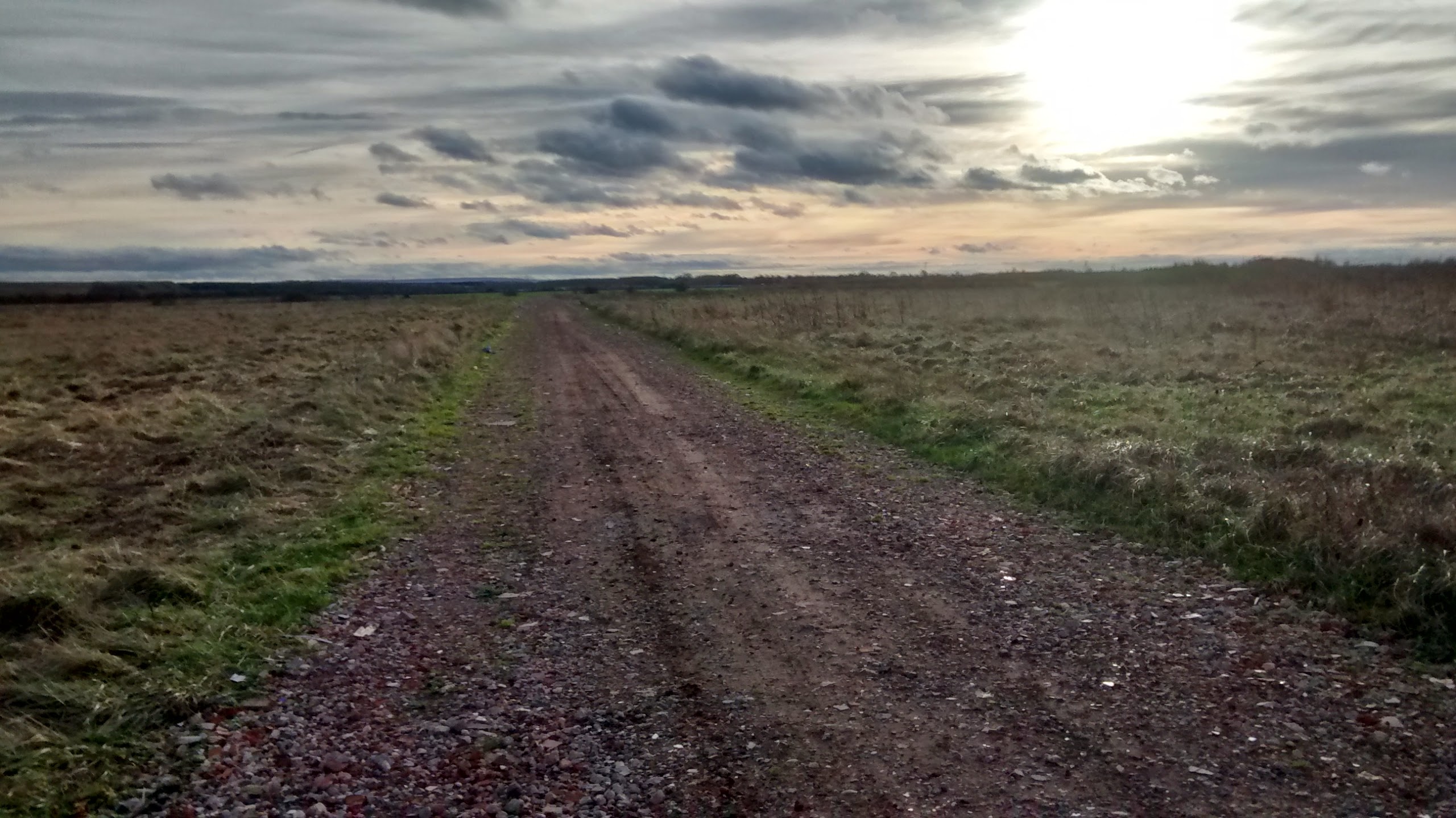
Owl country road

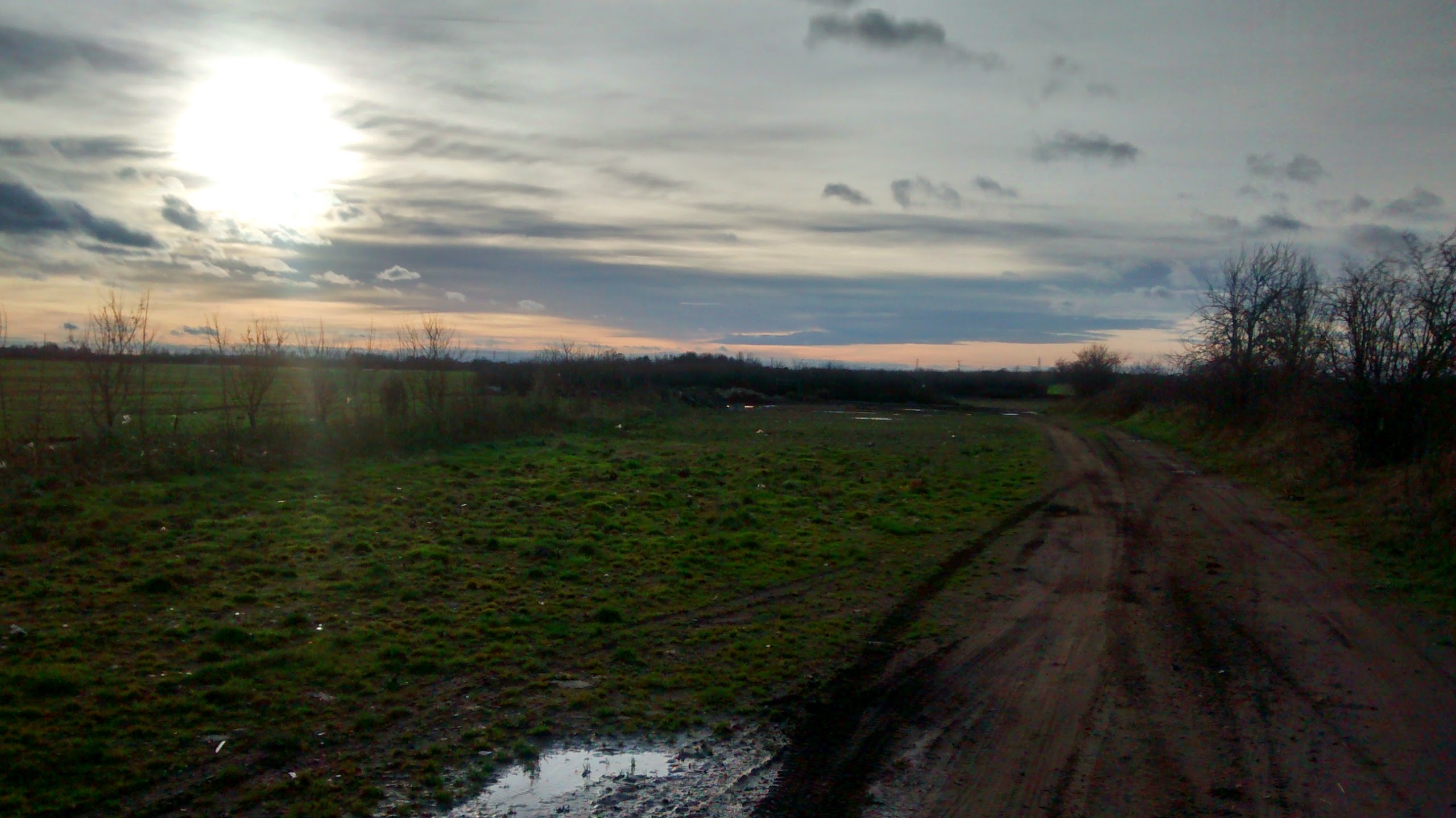
The road I took

The road I didn't take

Tarmac path to Cotham flash

Waterless flash

A big cog

No wigeon here today

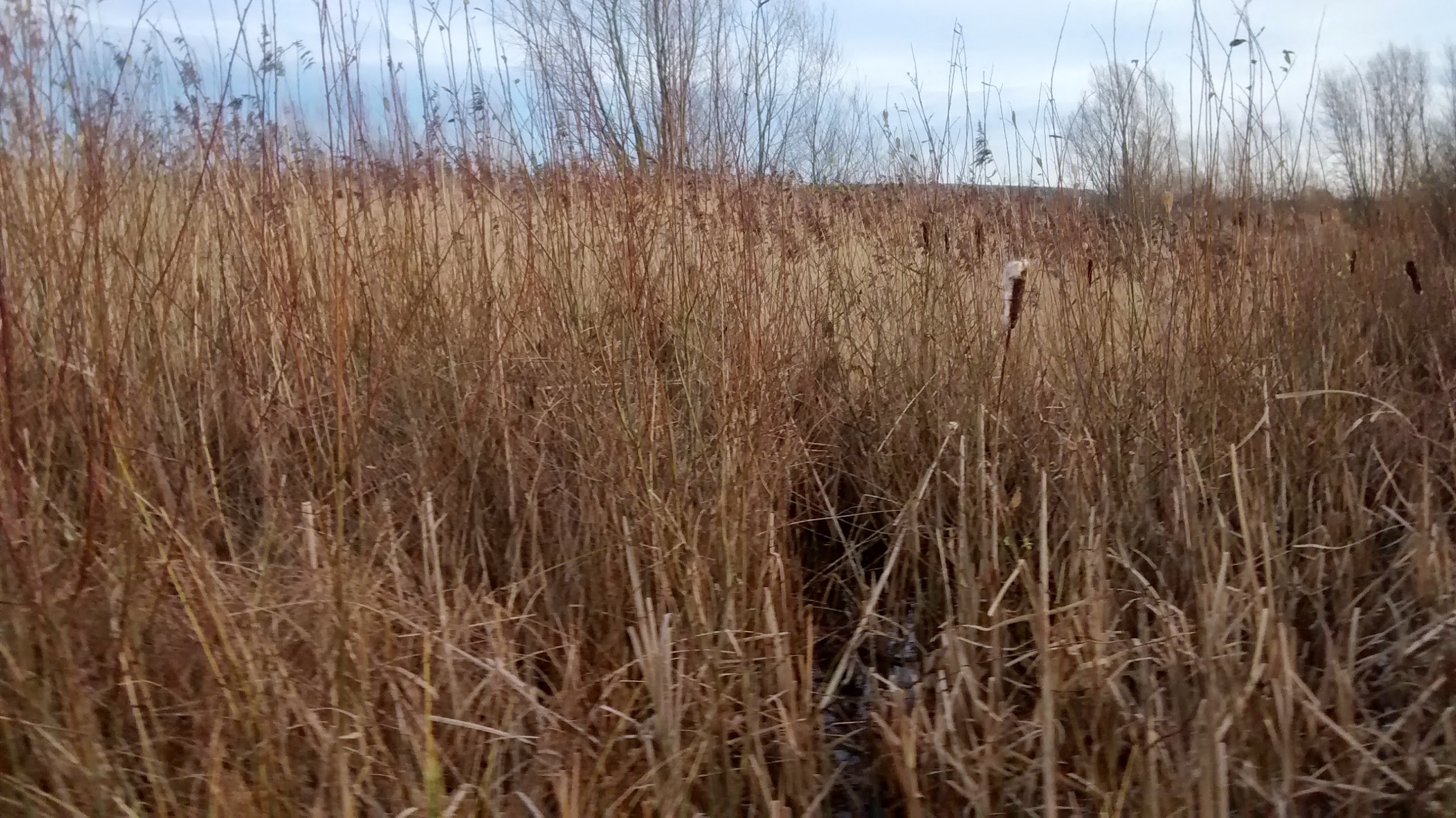
Bull rushes

Down in the reeds
posted from Bloggeroid

Friday, 19 December 2014

Final Geminid 2015 Report

Well, the final report is one of disappointment after the 2015 Geminid meteor shower started so well here in Newark!

My first proper observation session took place at 2am on the night of the 12th-13th. It was well below zero, but warmly dressed, it was strangely pleasant reclining on a garden chair in the frost, watching the stars crisply pierce the black vault above.

In the 45 minute session I had, I observed 8 Geminids, none brighter than 2nd magnitude and most fainter. The last quarter moon was providing some interference in the East, but bright meteors were still easily visible. In fact the brightest I saw were two sporadics of first magnitude streaking North - South through Leo, against the tide as it were.

The night of maximum, the 13th-14th (Saturday-Sunday) commenced with me making a 7km run around the streets, including a trip up Clay Lane and to the Elm Avenue cricket ground. Here skies were dark, and I was certain of seeing meteors, or so I thought.

As it happened, during the 45 minute run with these frequent meteor stops, I saw no meteors, despite the gloriously clear skies. Of odd looks from dog walkers and car drivers, wondering who this neck craning athlete was, there were many. Of shooting stars, there were none.

However, during a 15 minute session later on where I observed from a well lit street, I saw 5 meteors at around 8pm and was really hopeful of a fantastic night of illuminations. Ha ha. In the great tradition of British weather, clouds rolled in from nowhere at around 9pm and blanked the sky out for the rest of the night.

Cruel. So cruel.

The night of post maximum was the same, and the one after. Finally, on the Tueday night, I saw my final Geminid of the shower, a proud but strangely sad specimen heading East leaving a short trail.

No more.

It could have been so darn good!

Tuesday, 16 December 2014

A Traverse of Owl Country

After my muddy and frosty cross country slog on Saturday, I found I wasn't done with running adventures for the week, and today headed back to the owl country beyond British Gypsum (or whatever it is called now!).

I had no idea where it led, but I was determined to follow the track within to its conclusion.

It is a bleak spot on a grey day with the sun already beginning to sink down into the dirty grey blankets of the horizon. It is good country for owls - open, scrubby with plenty of cover for rodents, with a few bushes and trees for the raptors to perch in. It reminds me of the open wasteland near my work, where I have seen barn owls hunting at dusk.

Alas, I saw no owls. There were plenty of cawing crows, and as I ran along the broken surface of the track, I flushed out a small flock of brown birds from cover, probably partridges. The path led down to a farmer's field, I had an idea it might eventually lead the to the bridleway off the Hawton Road, but as I turned right, and the track became concrete, it became clear I was heading for the Cotham Flash area.

Magpies sat on fenceposts, seagulls wheeled overhead. I wondered if a flock of whistling wigeon would take to the air at my approach. No joy. The most exotic sight I had all run was a big flock of pigeons, aimlessly wheeling above some kind of field of brassicas.

But, it's a new route found, and assuming I can avoid any folk on off road bikes, it's one I'm going to be running a lot more in future. Especially as it naturally takes me back past Rumbles Cafe.

Sunday, 14 December 2014

There's a Kingfisher on my Patch!

I set off today on a gentle 10km jaunt round town, not wishing to overstrain after the rather more taxing cross country slog yesterday.

I had only just gone through the kilometre mark, dropping down onto the cycle path from London Road, when I caught sight of a vivid red breast sat on a low branch. My first thought was, "Bullfinch!" - the vivid strawberry split colour of the breast was highly reminiscent of those chunky little finches although I'd never seen one on the cycling path.

But then the bird flew off from its perch above the drain on the left of the path, and flew off to a tree next to the lake. As it did so, the expected white rump did not appear; instead, it was the neon blue back of a kingfisher that headed off to a new, human-untroubled fishing spot.

This must have been the same bird I'd seen a few days before, between the Barnby Lane and Clay Lane bridges; they are known to have waterfront territories extending over a mile. But to see it down on the cycle path, on my patch, is an amazing treat. Such a beautiful bird, and I'll wager so many of the dog walkers and pram pushers, runners and cyclists, are unaware it is there.

I've no idea why it has decided to settle in on the Sustrans 64 drains compared to where it was before, and we've never had a resident kingfisher along here in the 6 or 7 years I've been running this route. There are certainly rich pickings of sticklebacks and toadlets to be found in the shallow water, but it is a busy stretch in terms of human activity and noise.

Whatever the reason, I'm delighted it has decided to stick around on my regular running route. I hope to see plenty more of it.

Saturday, 13 December 2014

The Frosts, Forests and Raptors of Cotham

I missed Parkrun and someone told me I was fat last night.

At least when I missed Parkrun I was in my bed sleeping. No such joy about the chubby incident - caused by Tourette meds - and it resolved me to to a "show 'em" run.

Hence I ran a shade under 16km today, along an occasionally slippery cycle path decorated with winter thrushes, including a big flock of fieldfare at the solar farm, to Cotham. There I turned back for town, and mentally cancelled my plans to do the super long Farndon route when I realised how icy the road was in places. Ever since I smashed my elbow in 2005, I've become rather paranoid of frosts, and with my balance already affected by labrhynthitits, I tend to tread very carefully.

The Hawton to Farndon road is a notorious ice rink, so thought it best to avoid.

Instead I searched for adventure elsewhere. There were footpath signs over a flytip just out of the village, and found myself in a small wood full of frozen hoofprints and vivid green moss. I ran out of path, no matter I backtracked, and a little later headed up another grassy lane fringing Pykett's Wood, following a path around a field full of fieldfares, and lined with hedges sporting yellowhammer and reed bunting.

It was a little further along here, as the path narrowed and darkened under the trees, I had my "sight of the day" and a spectacular one it was too. A sparrowhawk, clearly carrying prey of some kind in its talons, erupted out of the tree line and flew along the path 20 metres ahead of me, and right at ground level. It was being languidly followed by a great, slow flapping buzzard that didn't have its aerial speed or agility, but knew the chance of some dropped carrion when it saw it.

A little later this sparrowhawk must have found a safe perch on which to feast on what was probably a small songbird, but was disturbed by the neon Aldi plumage of the running me, at which point it flew off through the branches like a slalom roller skater, reaching top speed in barely a few flaps.

I've seen one chase a bird under a car port and down the side passage of a house, but this was even more impressive as the bird was laden down. I'm seeing plenty of raptors this winter, and this can only be a good sign.


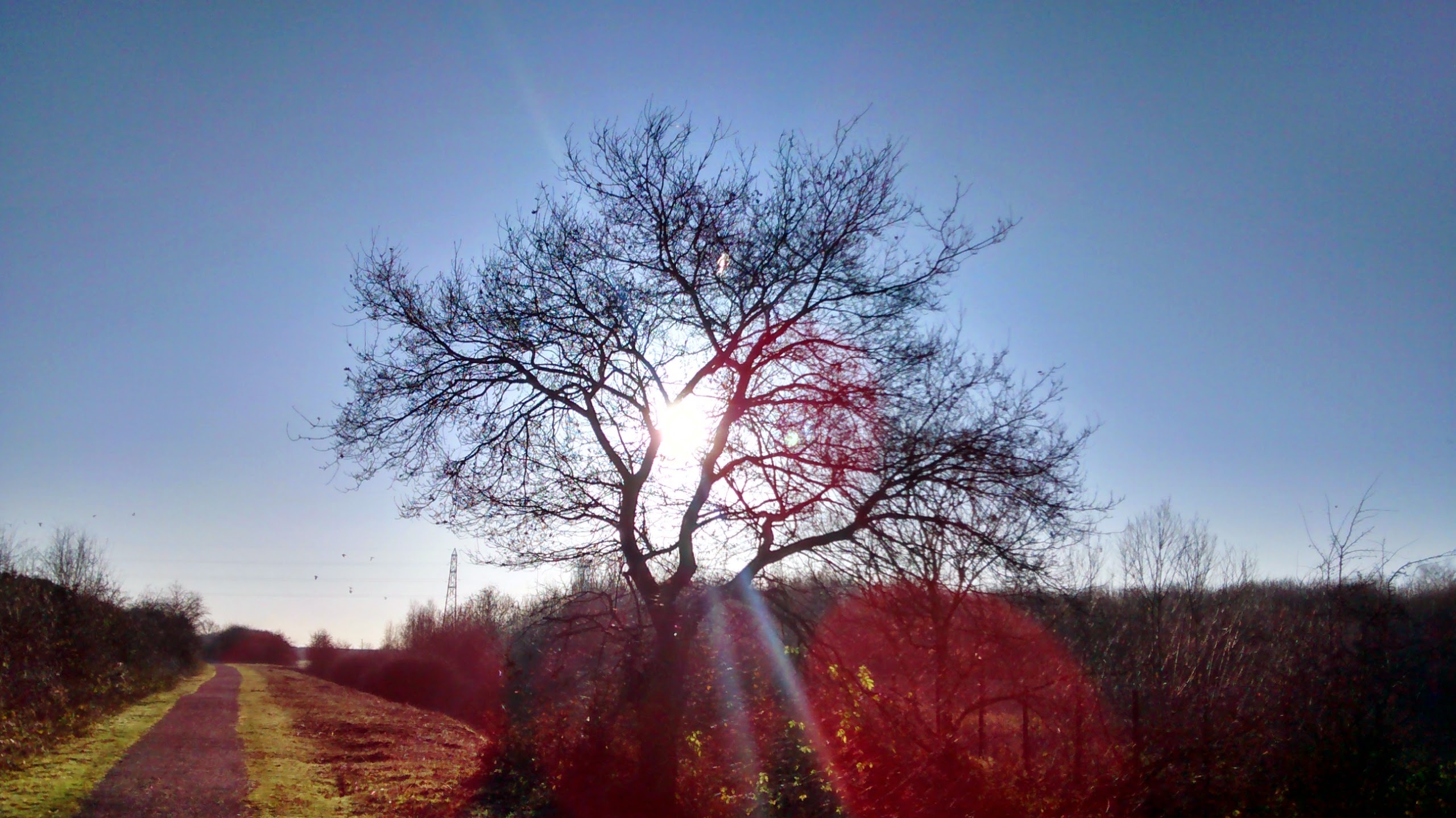
Backlit tree, Sustrans 64

View across to the distant sugar factory

The sun wasn't low, I actually have giant legs

Another adventure beckons, the path towards Bottesford

Ten mile view, Cotham

Exploring a small wood

Livid green moss

Among the trees

Mr Freeze the horse

The devil's hoofprints

Towards Pykett's Wood

The sparrowhawk path

Please don't shoot me

Poplar wood

River Devon

Golden Hawton church
posted from Bloggeroid

Tuesday, 9 December 2014

Time to Enjoy the Geminid Meteors

For many many years, it was the night of August 12th that was the most looked forward to on the shooting star watcher's calendar; the night of the annual Perseid maximum.

Despite their reputation, the Perseids have many drawbacks as a spectacle. For a start, the radiant, the point in the sky from which the meteors appear to originate from, rises very late in the UK, and thus the optimum time for observing the meteors is well past midnight. Also, in mid summer, the skies are never as dark as they are in winter, and so some fainter meteors will be drowned out in the deep twilight conditions.

Thirdly, the weather has not been great the last couple of years, with the night of maximum often clouded out.

The Geminids, which will reach maximum this weekend on the night of 13th-14th December, seem to have overtaken the Perseids as the most reliable shower of the year. For a start they have a longer build up, allowing meteors to be seen in the week to ten days prior to maximum. They tend to be slower moving and brighter, and thus easier to see. The winter skies are darker and crisper, allowing fainter meteors to be seen. And finally, the radiant is already reasonably high in the sky by the early evening, and not far from overhead by midnight which makes them a spectacle children can enjoy too.

Unlike meteor showers like the Perseids and Leonids - associated with the comets Swift-Tuttle and Temple-Tuttle respectively - the source of the Geminids seems to be the asteroid Phaeton, an object with an orbit that takes it twice as close to the sun as the planet Mercury, raising its temperature to 750C in the process.

I saw my first Geminid of the 2014 season last night at about midnight, streaking through the constellations of Triangulum and Australia. Just after it did so, a pair of canada geese flew low overhead, softly glowing in the moonlight. It just went to emphasise what magical sights there are to have while meteor watching.

The best time for observing Geminids this year will probably be up to midnight - one am on the night of the 13th-14th - after this, a last quarter moon will start to interfere although plenty of brighter meteors will still be visible. Unlike the Perseids, which tend to be seen closer to the radiant, Geminids tend to wander much further across the sky. Because of this, a reclining chair with a good view of the zenith might well be the best place to watch the meteors from, although remember for the love of all that's holy to wrap up warm this time of year. A good view of the Southern portion of the sky might be best, particularly later on.

Watch for the colour of the meteors. Often Geminids will appear to have a markedly orange hue compared to the Perseids, and often they leave a smokey trail too. They may also appear to "wobble" slightly as they travel across the sky.

So lets hope for clear skies, and not too much in the way of savage frosts or numbing gales, and let us see what we shall see.

Good hunting!